


AI in the Creative Industry: The Real State of the Art
A blog essay about AI in the creative industry and why everything feels like a loading screen stuck at 99 percent.
Every time I finish a personal artwork, my brain goes into this reflective mood where I start connecting dots that probably should not be connected, but anyway, here we are. State of the Art came out of me with a very specific itch, and that itch was basically a year-long scream about the bizarre world artists are dealing with in 2025.
Because let’s be real. Making art right now is a trip. You swim in endless feeds packed with ads, reaction loops, TikTok dances, AI generated content, algorithm driven creativity, and people fighting for a sliver of attention. And somehow we, the artists, are still expected to create something meaningful that cuts through the noise, has emotional depth, and convinces someone to stop scrolling for more than the lifespan of a confused insect. The behind-the-scenes reality gets stranger every week.
Before I dig into the artwork itself, let me address the title. Yes, it is a word play. I am not even pretending otherwise.
State of the Art talks about the actual state of the art world and how unhinged everything feels. It also plays with the expression “state-of-the-art”, the one used to describe cutting edge technology. The joke is that the tech shaping our lives is racing at lightspeed, while the humans trying to keep up look like we crawled out of a microwave with a kilowatt hangover. That tension is the heart of this piece.

So This Is the Actual State of the Art? Cute (or AI in the creative industry)
I have been illustrating covers for nearly two decades, and even though the creative industry always had its quirks, these last years feel like someone swapped reality for a glitchy beta version. Everything is faster. Everyone expects instant results. Attention spans are measured in TikTok dance challenges. As digital artists, we are asked to build entire surreal universes full of meaning that will be forgotten by next Tuesday, even if they took months of photomontage, matte painting, and emotional portraiture to craft.
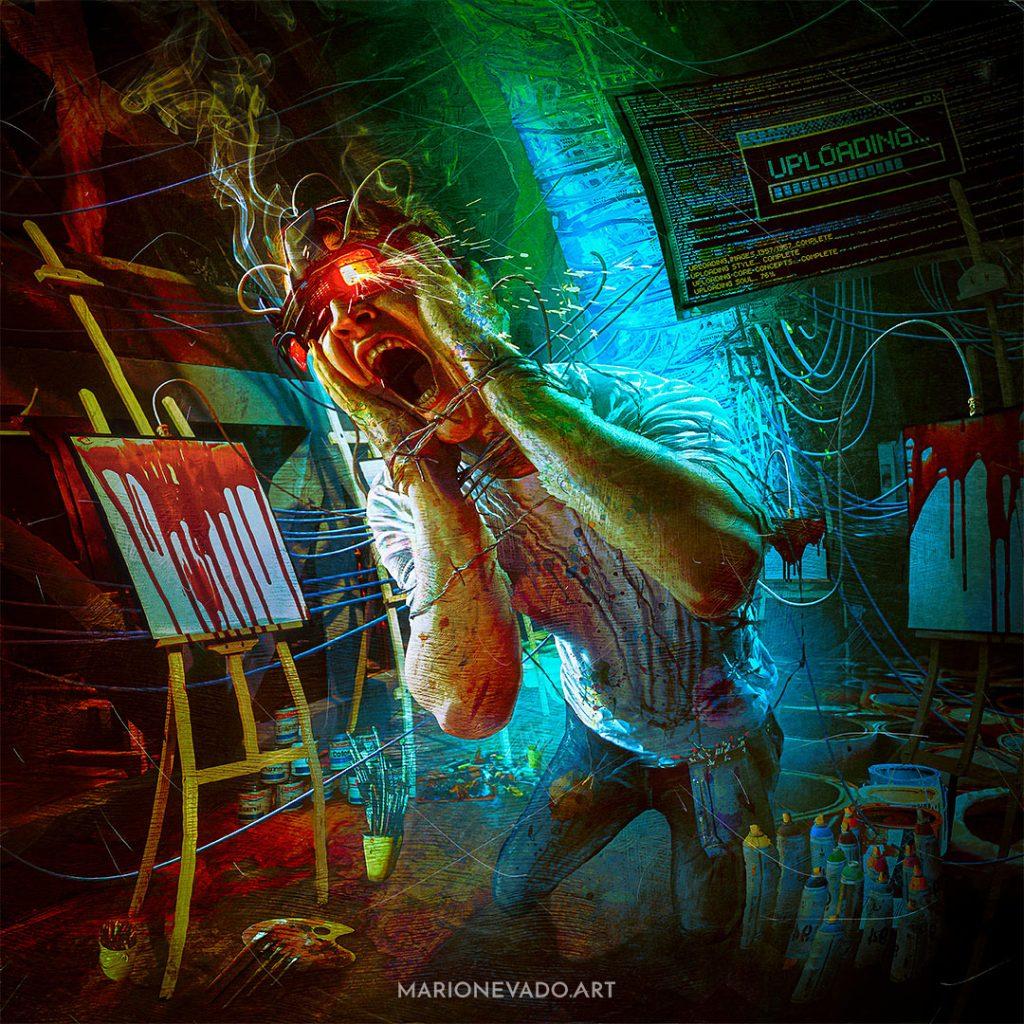
I wanted to capture that feeling in State of the Art. The artwork shows a figure pulled apart, overloaded, drained through cables feeding some almighty algorithm. The question I never thought I would ask suddenly felt real: do humans have a soul? The colors crash. The textures collapse. It mirrors what creative burnout feels like when the entire automation in creative industries ecosystem keeps speeding up.
The glitch effect in this illustration is handmade. No AI. I used digital painting, photography, and a Photoshop trick where I distort elements through content aware transforms, snap them back, distort them again, until the whole piece behaves like a corrupted file pretending to act normal. Hand-made glitch. Ethically sourced chaos. Perfect for the people who will still jump into my comments yelling that this is AI.

Riding the AI Rollercoaster Without Losing My Last Neuron (or AI misuse in creative work)
I was not always reluctant about AI. Back in 2021, I was the nerd running Disco Diffusion overnight with remote Google GPUs. Then I explored early Midjourney models for a whole year. I even trained my own datasets using my artwork to generate textures and surreal elements. It felt experimental and playful.
Then the truth surfaced. The scraping. The copyright mess. The lack of consent from artists. The corporate pipelines feeding these models into all kinds of questionable places. Suddenly it stopped feeling like a playground and started feeling like the punch bowl got contaminated.
I deleted everything AI generated from my socials. Then I earned a diploma in Artificial Intelligence and Mass Media from RTVE (Radio & Television National Broadcast, Spain), because if the ground was shifting under me, I wanted to understand the tremor instead of hanging from the furniture.

Turning a Full Artistic Meltdown Into Surreal Digital Art (or AI clients in the art world)
Then came the quiet year. Almost no jobs. I feared AI had replaced us. That authors and musicians were generating their covers with a prompt. Turns out something funnier and far more cursed was happening.
When work finally returned, almost every client arrived with the same pitch:
“I generated this AI image. Can you recreate it so it looks human and professional?”
Others came with impressively written briefs, crafted by what I now call the Algorithmic Gods. All sounding poetic, dramatic, and absolutely not written by a real person.
Welcome to the Age of Artificial Idiocy.
People who struggle to write an email were suddenly releasing 500 page novels. Clients were pasting my messages into chatbots and sending me the recycled output back. At one point, someone tried to license an AI image that looked like my work, had my name baked into the corner, and still insisted it was “copyright free”.
Imagine my soul leaving my body.

Declaring My Work Actually State of the Art (or generative AI challenges for artists)
The moment that truly broke my brain was a fantasy novel project. The emails were suspicious. The vocabulary was mechanically poetic. The brief felt like a Pinterest smoothie. It was a dark fantasy novel about a necromancer, in the universe of Dungeons & Dragons.
Then halfway through, came the legendary request:
“Make the central eye look like a red Rinnegan.”
That was it. That was when I realised, I was not working with a writer. In case you don’t know, a Rinnegan is a symbol from the anime Naruto, so naturally, nothing made sense moving forward. I was collaborating with someone feeding half sentences to a chatbot. The character descriptions were prompted. The feedback was prompted. Everything was prompted.
The project mutated into three editions with imaginary specs and evaporating deadlines. The client sent me mystical word salads full of cosmic radiance and transcendental aura gradients. I needed subtitles to survive.
And that was the exact moment I started sketching State of the Art.
Getting Humans to Understand All This in Under Two Seconds (or how AI is changing the creative industry)
This artwork is a snapshot of creative history. We are living inside a shift where everyone pretends to understand AI, but most people do not understand lighting, composition, or even basic grammar, for that matter (seriously, the difference between their prompted e-mails and the ones they sent without using ChatGPT was abysmal). Yet they want control of the visual world.
The figure in the artwork tries to stay whole while everything glitches around it. Colors clash. Textures fracture. It is beautiful and unsettling. It is human intuition wrestling with technology.
I do not think art is dying. I do not think AI is the villain. The real villain is the chaotic, confused, algorithm-saturated environment we are all stuck in. The people with no ethics that have always existed. And through all this noise, craft still matters. Emotional depth still matters. Personality still matters. Human weirdness still matters.
State of the Art is my little time capsule of this era. A reminder that the burnout we feel is not a personal failure. It is a natural reaction to a system spinning too fast.
If you are a creator, protect your energy.
If you are a client, read your emails.
If you use AI, at least learn the field you are stepping into.
And if anyone ever asks you to make something look like “a red Rinnegan but more spiritual”, that is your sign to close the laptop and move to the forest.
Thanks for reading, for caring about surreal digital art, and for sticking around in a world where attention spans are timed with a stopwatch. State of the Art exists because people like you still want depth in a world built for speed.



Picoo
Outstanding article! Has this experience changed what projects you say yes to now?
Mario Nevado
Hey Picoo! Yes, it definitely has. With some tact and some new clauses in my licensing contracts I’m managing to make some clients to be human again… I think!